Tracey & Ernie Richardson beschrijven in hun boek The Toyota Engagement Equation - How to Understand and Implement Continuous Improvement Thinking in Any Organization wat zij - op basis van hun ervaring bij Toyota - verstaan onder de A3-methode:

As problem solvers and change agents, it was critical that we followed a standard procedure when we made changes so that all those affected would be on the same page. Getting everybody to understand and internalize a common approach to problem solving was therefore central ... This involved, essentially, coaching and teaching by example through actions that aligned with the PDCA mindset and supported the True North of the company.
Usually, the problems encountered in the workplace were small and could be addressed on the spot through a simplified version of PDCA thinking. Sometimes, however, a change would affect multiple stakeholders, which meant that a number of people had to understand the proposed change and provide input and support. To accomplish this, we had a standard process for documenting the change process so that everybody affected could be on the same page.
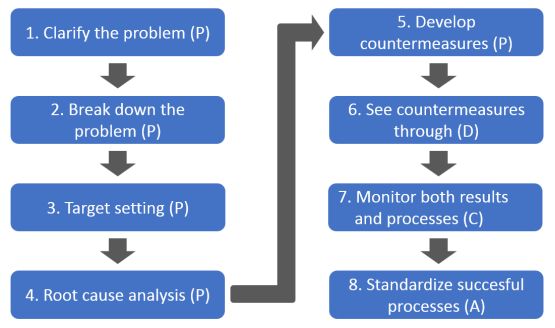
The method we used is called A3, named for the double-sized, 11x17 (inch, BS) sheet that the report is usually presented on. The A3 method follows the eight-step problem-solving process we used internally, which was closely modeled on PDCA. The eight steps expand on the PDCA principle, creating a powerful sequence of actions that ensure that the scientific discipline behind PDCA is properly maintained throughout. The eight steps prescripe certain actions, but more important, they reflect a way of thinking that is central to the realization of Toyota's values.
(...)
Today, the eight steps are taught as follows, showing the corresponding PDCA steps.
-
Clarify the problem (P).
-
Break down the problem (P).
-
Target setting (P).
-
Root cause analysis (P).
-
Develop countermeasures (P).
-
See countermeasures through (D).
-
Monitor both results and processes (C).
-
Standardize succesful processes (A).
As we follow the eight steps through the PDCA cyucle, we use A3 to create a document that others can see and understand easily. This form of "standardized storytelling" is key within any culture practicing PDCA thinking and can be a powerful tool to engage and empower leaders as well as the front lines. The A3 cuts across all functional silos and can become the common language for succesful Lean transformation. I like to call this "Lean communication", or a "5S of information", enabling you to share your thinking with others. People don't need to know everything you did to get there, just the key points that show the logic of the steps and the meaning behind them.
The steps show just how much thime we spent planning. My trainer once said that if there was a project that took 12 months, we would spend 9 months planning and 3 months implementing. He jokingly said other companies usually did the opposite - planned for 3 months and had a very frustrating 9-month implementation wiht a lot of rework. The trainers encouraged us to always invest in planning and following the process. This can be often be the determining factor in whether or not a project adds value to the organization.
(...)
The main goal for A3s, therefore, was to "share wisdom" (the thinking of others) in order to develop people with a common lens.... Perhaps the most important aspect [is] the thinking behind the paper, not the A3 paper itself, that is most important. The written A3 can never be the result of just filling out a form - by filling the squares, we are effectively verifying the thinking, and that we have asked the approriate questions of ourselves and our coworkers in the process, and shown due respect to all of the people involved, regardless of their role or function in the organization.